
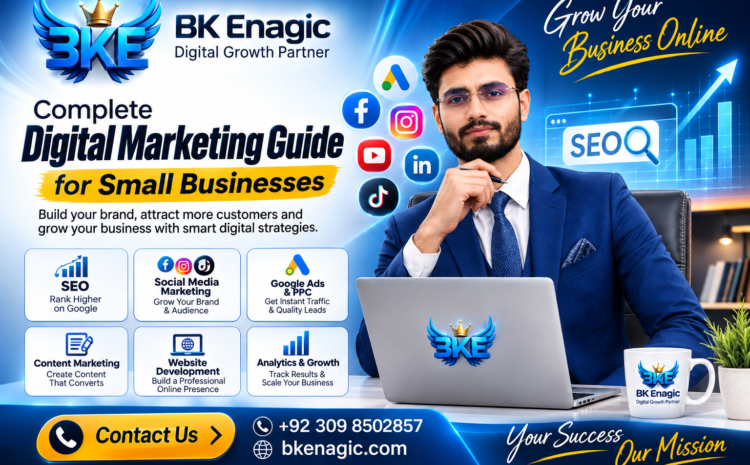
Complete Digital Marketing Guide for Small Businesses Six Powerful Pillars for Online Growth
Running a small business today is not only about having a great product or providing excellent service. Customers need to be able to discover your business, understand what you offer, trust your brand and take an easy next step such as calling, sending a WhatsApp message, requesting a quotation or making a purchase.
That is where digital marketing becomes important.
Digital marketing connects your website, Google visibility, social-media presence, useful content, paid advertising and performance data into one customer-acquisition system. Instead of depending on a single marketing channel, businesses can use several channels together so that customers encounter the brand at different stages of their buying journey.
Google describes SEO as helping search engines understand website content while helping users discover a site and decide whether to visit it. Google Ads, meanwhile, is designed to put businesses in front of potential customers when they are searching for relevant products and services.
For a small business, that distinction matters. Someone may discover your company through Instagram, research you on Google, visit your website, read a useful blog post and then contact you through WhatsApp. Digital marketing works best when those activities support one another rather than operating as disconnected campaigns.
At BK Enagic, the goal is to combine digital channels such as website development, SEO, social media and digital advertising into a strategy focused on measurable business growth. BK Enagic currently promotes these areas alongside AI-powered video advertising and related digital services.
The following six pillars provide a practical framework for building that strategy.
Build a Strong Digital Foundation
Before spending heavily on advertising or producing dozens of social posts, a small business should first create a reliable digital foundation.
Your website is one of the most important parts of that foundation because it gives potential customers a place to understand your company, evaluate your services and take action.
A strong small-business website should clearly communicate:
- What your business does
- Who your products or services are for
- Why customers should choose you
- Which locations you serve
- How customers can contact you
- What action visitors should take next
The website should also work effectively on mobile devices, load quickly and make important information easy to find.
Website performance is not only a technical issue. Google’s Core Web Vitals measure real-world aspects of user experience, including loading performance, responsiveness and visual stability. Google currently recommends a Largest Contentful Paint of no more than 2.5 seconds, Interaction to Next Paint below 200 milliseconds and Cumulative Layout Shift below 0.1 for a good experience. Google also emphasizes that strong Core Web Vitals alone do not guarantee high search rankings; they are one component of a broader page experience mensstore.
For small businesses, however, the principle is simple:
Do not send valuable visitors to a website that is slow, confusing or difficult to use.
Your brand identity should also remain consistent across the website, Facebook, Instagram, LinkedIn, Google Business Profile and advertising campaigns. Logos, brand colors, service descriptions, phone numbers and other important details should feel like they belong to the same business.
A practical digital foundation therefore includes a professional website, clear branding, conversion-focused pages, fast performance, mobile usability, reliable contact information and analytics tracking.
This is particularly relevant to BK Enagic’s service model because the company presents web development as part of its wider digital-marketing offering rather than treating a website as a stand-alone product.
Improve Visibility with SEO and Local Search
Having a website is only the beginning. Your potential customers must also be able to find it.
Search Engine Optimization, or SEO, involves improving your website so search engines can understand its pages and potential customers can discover them through relevant searches. Google specifically advises website owners to focus on useful, understandable content and sound website organization rather than thinking of SEO simply as manipulating rankings.
For a small business, SEO should begin with the searches that have genuine commercial value.
For example, instead of trying to rank for extremely broad terms, businesses can create pages around more specific customer needs such as:
“digital marketing agency in Pakistan”
“SEO services for small businesses”
“web development company in Lahore”
“social media management services”
“Google Ads management for small business”
The exact keywords will depend on the business, its services and the areas it serves.
A strong SEO strategy should align each important product or service with a dedicated page. Those pages should explain the service clearly, answer common customer questions, demonstrate expertise and make the next step obvious.
Content is another major component. A service page might target someone ready to hire a company, while a blog post can answer an earlier-stage question such as:
How much should a small business spend on Google Ads?
or:
How can a local business improve its Google ranking?
By covering both commercial and informational searches, a business can reach customers at different stages of the buying process.
Local visibility matters too
Businesses serving specific cities or geographic areas should pay special attention to Google Business Profile.
Google states that Business Profiles can appear in both Google Search and Maps and recommends verifying the profile, keeping information accurate, responding to reviews and adding relevant photos and videos. Google explains that local results are mainly determined by relevance, distance and prominence/popularity.
That means local businesses should keep details such as their business category, service area, opening hours, contact information and website accurate and consistent.
Customer reviews also deserve attention. Responding professionally to reviews can show potential customers that the business values feedback, and Google itself recommends replying to reviews as part of Business Profile management.
SEO is therefore not simply about adding keywords to pages. It connects technical website quality, helpful content, search intent, local information and business credibility.
BK Enagic already publishes content around SEO, local SEO and the evolution of AI-assisted search, making this pillar a natural place to internally link to the website’s more detailed SEO resources.
Grow Trust with Social Media and Content Marketing
SEO helps customers discover what they are actively searching for. Social media gives businesses another opportunity: staying visible before the customer is ready to search or purchase.
For many small businesses, platforms such as Facebook, Instagram and LinkedIn can support brand awareness, customer communication, community building and lead generation.
Meta’s current guidance for small businesses identifies benefits of social-media marketing including cost-effective reach, community-led growth, customer service and support across different stages of the marketing funnel. Meta also recommends building a strategy around business goals and continuously optimizing based on performance.
The key word is strategy.
Posting random images every day does not automatically create business growth.
A better approach is to build several repeatable content themes. For example, a small service business might rotate between:
Educational content: tips, guides, FAQs and problem-solving posts.
Authority content: case studies, completed projects, client results and industry insights.
Trust content: testimonials, reviews, behind-the-scenes material and team introductions.
Service content: explanations of specific services and how they solve customer problems.
Conversion content: limited-time offers, consultations, quotation requests and direct calls to action.
The “Complete Digital Marketing Guide for Small Businesses” creative you provided is an example of educational content. Instead of immediately saying “buy our service,” it introduces business owners to six important marketing areas and establishes BK Enagic as a company that understands the complete digital-growth process.
That same post can be repurposed into multiple pieces of content:
A carousel can explain each of the six marketing pillars individually. A short video can summarize the guide. A LinkedIn post can discuss common digital-marketing mistakes. An Instagram Reel can cover three quick small-business SEO tips. A longer blog article—such as this one—can capture Google search traffic and provide a destination for users who want more detail.
This creates what can be thought of as a content ecosystem: one central idea becomes useful material across the website and social channels.
BK Enagic already offers social-media management and publishes educational content around the benefits of social-media marketing, which means this blog can also reinforce existing topical coverage rather than introducing an unrelated subject.
Content marketing works on a similar principle.
Instead of repeatedly asking people to buy, the business publishes information that helps customers make better decisions. Good content can answer questions, explain problems, compare options, demonstrate expertise and guide customers toward a solution.
For example, a digital-marketing agency could publish:
“How to Choose a Digital Marketing Agency in Pakistan”
“SEO vs Google Ads: Which Is Better for a Small Business?”
“How Much Does a Professional Website Cost?”
“Best Social Media Strategy for Local Businesses”
“Complete Local SEO Checklist”
“How AI Search Is Changing SEO”
BK Enagic already has articles covering several adjacent topics, including how to choose a digital-marketing agency, Google Ads for small businesses, social-media management and AI search. Those pages are strong internal-link candidates from a broader guide like this one.
Generate Faster Demand with Google Ads and PPC
SEO and content marketing can build visibility over time. Paid advertising can help a business reach potential customers more immediately.
Google Ads is especially useful when people are already searching for a product or service.
Google describes its advertising platform as a way to reach potential customers interested in a business’s products or services while providing measurement of actions such as ad clicks. Search campaigns can target specific keywords and are intended to support objectives such as generating leads, increasing sales and driving website traffic.
Consider a customer searching:
“SEO company near me”
or:
“website development company in Pakistan.”
That person is demonstrating stronger commercial intent than someone casually scrolling through social media. Search advertising can place a relevant business in front of such users at the moment they are actively looking for an answer.
However, small businesses should avoid treating Google Ads as simply “pay money and get customers.”
A successful paid-search strategy depends on the relationship between the keyword, advertisement, landing page, offer and conversion tracking.
For example:
Search: “SEO services for small business”
Ad message: Professional SEO Services for Small Businesses
Landing page: A dedicated page explaining small-business SEO
Call to action: Request a Free Consultation
This creates continuity from search intent to conversion.
Businesses with a physical location or service area can also use location-focused advertising. Google states that Search Ads on Maps can help businesses with physical locations or service areas reach nearby users, and associated interactions can include requests for directions or mobile clicks to call.
Small companies should begin with clearly defined objectives rather than trying to advertise everything at once.
If the goal is qualified inquiries, measure qualified inquiries.
If the goal is phone calls, track calls.
If the goal is WhatsApp conversations, measure clicks that lead to genuine conversations and sales.
If the goal is e-commerce sales, track completed purchases and revenue.
That distinction prevents a common digital-marketing mistake: celebrating traffic while ignoring business outcomes.
BK Enagic’s digital-marketing offering explicitly includes Google-oriented advertising as part of its broader mix, while the company’s blog also contains a dedicated article on Google Ads strategies for small businesses.
Measure Performance and Scale What Works
The final pillar is the one that turns digital marketing from guesswork into a repeatable business process: analytics.
A small business should know which marketing activities generate attention, which generate leads and which contribute to actual revenue.
Google Analytics provides acquisition reports that help businesses understand how users arrive at a website or app. Google distinguishes between user acquisition, which focuses on how new users were initially acquired, and traffic acquisition, which examines where sessions originate across channels.
Rather than checking dozens of numbers, most small businesses can begin with a focused set of metrics.
| Marketing area | Useful metrics |
|---|---|
| Website | Visitors, engaged visits, form submissions, calls |
| SEO | Search impressions, clicks, rankings, organic leads |
| Local SEO | Calls, website visits, directions, reviews |
| Social media | Reach, engagement, profile visits, inquiries |
| Content | Organic traffic, engagement, assisted leads |
| Google Ads | Clicks, cost per click, conversions, cost per lead |
| Overall business | Qualified leads, sales, revenue, customer acquisition cost |
Google Analytics reports are designed to help website owners monitor traffic, investigate data and understand user activity, while acquisition reporting can separate traffic from channels such as organic and paid sources.
The important question is not simply:
“Did website traffic increase?”
It is:
“Did the right traffic increase, and did that traffic create more business?”
Imagine a campaign generates 10,000 visits but only two serious inquiries. Another campaign generates 500 visits and 25 qualified inquiries.
The second campaign may be far more valuable even though its traffic figure looks smaller.
This is why digital marketing should operate as a continuous cycle:
Strategy → Launch → Measure → Learn → Improve → Scale
Successful channels receive more attention and budget. Weak landing pages are improved. Underperforming keywords are adjusted. High-performing content is expanded. Social posts that resonate with the audience inspire future campaigns.
Over time, these improvements can make the entire marketing system stronger.
Turn the Six Pillars into One Growth System with BK Enagic
Digital marketing for a small business does not need to become unnecessarily complicated.
Start with the fundamentals:
Build a strong digital foundation.
Create a professional, fast and conversion-focused website.
Improve your search visibility.
Use SEO and Google Business Profile optimization to help customers discover your business.
Build relationships on social media.
Publish useful, consistent content instead of relying exclusively on promotional posts.
Create valuable content.
Answer the questions potential customers are already asking.
Accelerate demand with paid advertising.
Use Google Ads and other paid channels strategically when faster reach is required.
Measure everything that matters.
Track leads, customers and revenue—not just likes, impressions and clicks.
No single channel needs to carry the entire business. The real opportunity comes from making the channels support each other.
A customer might see a BK Enagic social-media post, search for the company on Google, read an SEO article, review the company’s services and then make contact. That journey is exactly why businesses benefit from an integrated approach rather than isolated marketing activities.
BK Enagic currently positions its offering around professional web development, SEO, social-media management, digital marketing and AI-powered video advertising, with its website and content focused on helping businesses strengthen their online presence.
For businesses that want to improve visibility, attract better leads and build a more professional online presence, BK Enagic can help develop a digital strategy built around the channels that matter most to the business.
Ready to grow your business online?
Contact BK Enagic for website development, SEO, social-media marketing and digital advertising services. The company’s published contact information lists +92 309 8502857, and its website currently promotes digital-growth services for businesses in Pakistan.
BK Enagic — Strategy. Visibility. Growth.
We Grow Businesses Online.


Write a Comment