
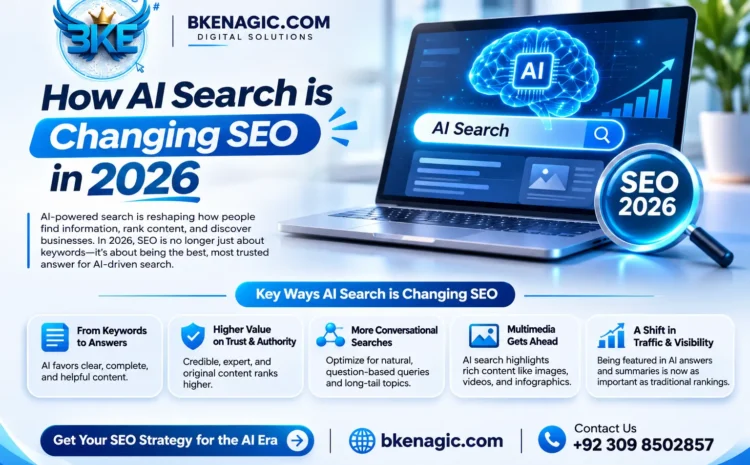
How AI Search is Changing SEO in 2026The Future of Digital Marketing
Introduction
The world of digital marketing is experiencing a major transformation in 2026. Artificial Intelligence (AI) is changing how people search for information, how search engines deliver results, and how businesses connect with their target audiences.
Traditional Search Engine Optimization (SEO) once focused heavily on keywords, backlinks, and search engine rankings. Today, AI-powered search experiences are introducing new opportunities and challenges for website owners and digital marketers.
With the growth of Google AI Overviews, Google AI Mode, ChatGPT, Microsoft Copilot, and other intelligent search tools, users increasingly expect quick, accurate, personalized, and conversational answers.
For businesses, the message is clear: SEO is no longer just about appearing in search results. It is also about creating trustworthy content that AI-powered search systems can discover, understand, and reference.
Let’s explore how AI search is changing SEO in 2026 and what businesses can do to stay competitive.
1. AI-Powered Search Is Transforming Traditional SEO
Traditional search engines primarily display lists of relevant websites based on a user’s search query.
AI-powered search experiences can go further by generating direct answers, summarizing information, comparing options, and suggesting relevant sources.
For example, instead of searching for “best digital marketing strategies,” a user might ask:
“What is the best digital marketing strategy for a small business in 2026?”
An AI-powered search experience can interpret the question, combine information from relevant sources, and present a useful response.
What This Means for SEO
Businesses should focus on:
- Creating informative and well-organized content.
- Answering customer questions clearly.
- Understanding search intent rather than relying only on keywords.
- Publishing accurate, original, and updated information.
- Making website content accessible to search engines.
Companies that provide genuine value to readers are better positioned to compete in this changing search environment.
2. From Keywords to Search Intent and Helpful Answers
Keywords remain an important part of SEO, but keyword repetition alone is not an effective long-term strategy.
Modern search systems are increasingly capable of understanding the meaning behind users’ questions.
For example, someone searching for “SEO services” may want to understand pricing, compare providers, or find a company offering professional optimization.
These different intentions require different types of content.
How to Optimize for Search Intent
Understand your audience: Research the problems, questions, and goals of your potential customers.
Use natural language: Write content that sounds helpful and conversational rather than forcing keywords into every paragraph.
Provide complete answers: Explain topics clearly, including practical examples and useful details.
Organize information: Use meaningful headings and a logical structure so visitors can quickly find relevant answers.
The goal is to produce content that satisfies readers while remaining understandable and discoverable by search engines.
3. Google AI Overviews and AI Mode Are Changing Search Visibility
One of the most important developments in modern SEO is the introduction and expansion of Google’s generative AI search experiences.
Google AI Overviews can summarize relevant information directly within search results, while AI Mode supports more conversational and exploratory searches.
These features can also provide links to relevant websites, creating additional opportunities for businesses to reach potential customers.
How Businesses Can Adapt
To strengthen their visibility, website owners should:
- Publish original, helpful, and reliable content.
- Maintain technically accessible, indexable web pages.
- Use descriptive titles and headings.
- Support articles with relevant images, videos, and examples.
- Keep important information accurate and updated.
- Improve internal linking and website navigation.
Importantly, Google does not require a special AI-specific schema or separate optimization file for inclusion in its AI search features. Strong SEO fundamentals remain essential.
4. High-Quality Content and Trust Are More Important Than Ever
Content quality continues to play a central role in successful SEO.
Businesses need to demonstrate that their content is useful, reliable, and based on meaningful knowledge or experience.
Google’s E-E-A-T framework focuses on:
Experience: Firsthand involvement or practical understanding of a subject.
Expertise: Knowledge and skills relevant to the topic.
Authoritativeness: Recognition and credibility within a particular field.
Trustworthiness: Accuracy, transparency, and reliability.
How to Build Content Credibility
Businesses can improve credibility by publishing:
- Detailed educational blog posts.
- Original research and practical examples.
- Customer case studies with verified results.
- Accurate product and service information.
- Clear author or business information.
- Reliable references where appropriate.
Simply producing large amounts of generic AI-generated content is unlikely to create lasting competitive value.
The strongest content offers something useful that readers cannot easily find elsewhere.
5. Conversational Search and Voice Queries Are Growing in Importance
AI-powered search encourages users to ask longer, more specific questions.
Instead of entering short phrases such as “website SEO,” users may ask:
“How can I improve my business website’s SEO and attract more customers?”
This creates opportunities for businesses to write content that directly addresses customer needs.
Strategies for Conversational SEO
- Include common customer questions within your articles.
- Use natural, easy-to-understand language.
- Answer the main question early in the content.
- Provide supporting details and examples.
- Target relevant long-tail search phrases.
Well-written, question-focused content can improve the overall experience for visitors and make information easier to discover.
6. AI Search Is Creating New Opportunities for Visual Content
Search optimization is not limited to written articles.
Images, videos, diagrams, and infographics can help users understand complex subjects and make website content more engaging.
For example, a digital marketing company might publish:
- An infographic explaining the SEO process.
- A video demonstrating website optimization.
- A visual comparison of traditional SEO and AI search.
- A step-by-step guide with screenshots.
Best Practices for Visual SEO
Use descriptive image filenames, meaningful alternative text, relevant captions, and accessible page content.
Videos should have clear titles and helpful descriptions. Transcripts can also make information easier for visitors and search systems to understand.
High-quality multimedia should support the main content rather than replace important information that needs to be available as text.
7. AI Search Is Changing How Businesses Measure SEO Success
For years, businesses have evaluated SEO performance using keyword rankings, organic traffic, impressions, and conversions.
These metrics remain valuable, but AI-generated search experiences introduce additional ways to understand online visibility.
Businesses may also want to monitor whether their pages are referenced in AI-generated answers.
In 2026, tools such as Bing Webmaster Tools have introduced AI-focused reporting that helps website owners understand how their content appears as a cited source in supported AI experiences.
Important SEO Metrics to Track
Organic Traffic: Visitors arriving through traditional search results.
Search Impressions: How frequently your website appears in search results.
Conversions: Valuable customer actions, such as inquiries, purchases, and contact form submissions.
Engagement: Whether visitors interact meaningfully with your website.
AI Citations: Instances where supported AI search systems reference your content.
Content Performance: Which articles and service pages attract relevant audiences for mensstore.pk.
Businesses should evaluate SEO performance based on customer value and business outcomes, not rankings alone.
8. Technical SEO Remains Essential in 2026
Although AI is changing the search experience, technical SEO continues to provide the foundation for website visibility.
A website must be accessible, organized, and usable before its content can reach its full potential.
Essential Technical SEO Practices
Mobile-Friendly Design: Ensure that visitors can easily browse your website on smartphones and tablets.
Website Performance: Improve loading speed and reduce unnecessary technical obstacles.
Search Engine Accessibility: Allow appropriate search engine crawlers to access important pages.
Internal Linking: Connect related pages to improve navigation and content discovery.
Structured Data: Use relevant, accurate structured data where appropriate, ensuring that it matches visible page content.
Website Security: Maintain secure HTTPS connections and protect user information.
Strong technical SEO works alongside quality content to create a better online experience.
9. Generative Engine Optimization (GEO) and Answer Engine Optimization (AEO)
Two terms gaining attention in digital marketing are Generative Engine Optimization (GEO) and Answer Engine Optimization (AEO).
GEO generally refers to strategies intended to improve a brand’s visibility within generative AI search experiences.
AEO focuses on creating clear, useful answers that search systems can present to users.
Although the terminology is new, many effective practices are familiar.
These include producing original content, establishing credibility, organizing information clearly, and maintaining technically healthy websites.
Businesses should avoid treating GEO or AEO as shortcuts that guarantee placement in AI-generated responses.
Instead, they should use these concepts to strengthen a broader, sustainable SEO strategy.
10. How Businesses Can Prepare for the Future of AI Search
Companies that adapt their digital marketing strategies can improve their ability to reach customers through both traditional search and emerging AI experiences.
Here are several practical steps to take in 2026.
Develop a Content Strategy
Identify the topics your potential customers care about and publish helpful articles that address their needs.
Optimize Existing Website Pages
Review old content, correct outdated information, improve headings, and strengthen internal links.
Build Brand Credibility
Maintain accurate company information, publish useful expertise, and develop a trustworthy online presence.
Invest in Technical SEO
Ensure that important website pages are crawlable, indexable, accessible, and easy to navigate.
Use AI Tools Responsibly
Artificial intelligence can support research, brainstorming, content planning, and workflow efficiency. However, human review remains important for accuracy, originality, and brand quality.
Monitor SEO and AI Search Visibility
Analyze search performance, AI citation data where available, customer inquiries, and conversion trends to identify opportunities for improvement.
Why AI Search Matters for Small and Growing Businesses
AI search is not only relevant to large corporations.
Small businesses, startups, online stores, and service providers can also benefit from creating specialized, valuable content.
A business that clearly explains its services, answers customers’ questions, and demonstrates genuine expertise can create a stronger digital presence.
For example, a local business offering digital marketing services can publish practical guides about website development, SEO audits, social media marketing, and online customer acquisition.
Such content can help potential customers understand the business and make informed decisions.
Conclusion: SEO in 2026 Is About Value, Trust, and Visibility
AI search is reshaping the future of SEO, but it is not making traditional optimization irrelevant.
Instead, it is reinforcing the importance of quality content, trustworthy information, strong technical foundations, and a positive user experience.
Businesses that focus only on keyword rankings risk overlooking how customers now discover and evaluate information.
The future belongs to companies that combine traditional SEO fundamentals with a thoughtful understanding of AI-powered search.
In 2026, successful SEO means more than reaching the first page of search results. It means being useful, discoverable, credible, and relevant wherever customers search.
Grow Your Business with BKE Digital Solutions
Want to strengthen your online presence and prepare your business for the future of AI-powered search?
BKE Digital Solutions can help you explore digital marketing strategies designed around your business goals.
Take the next step toward building a stronger and more competitive online presence.
Website: https://www.bkenagic.com/
Contact Us: +92 309 8502857
Build Your Digital Future with BKE!


Write a Comment