
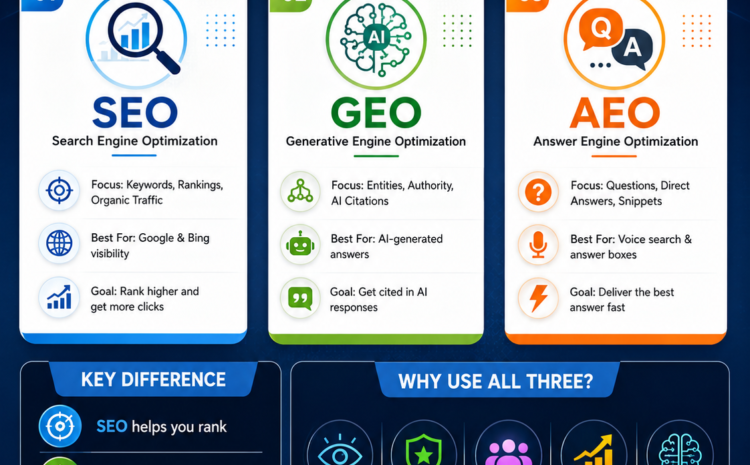
SEO vs GEO vs AEO Complete Comparison for Modern Digital Marketing
Search is changing rapidly. Businesses are no longer competing only for traditional Google rankings. They also want their content to appear in featured answers, voice-search results, Google AI Overviews, Microsoft Copilot and other AI-powered platforms.
This change has introduced three important digital marketing strategies:
- SEO — Search Engine Optimization
- GEO — Generative Engine Optimization
- AEO — Answer Engine Optimization
Although these strategies share many principles, they focus on different types of search experiences. Understanding the difference between SEO, GEO and AEO can help your business build a stronger online presence and attract customers wherever they search for information.
What Is SEO?
SEO stands for Search Engine Optimization. It is the process of improving a website so that its pages can rank higher in traditional search-engine results.
SEO normally focuses on search platforms such as Google and Bing. The objective is to increase organic rankings, website traffic, leads and sales.
A successful SEO strategy may include:
- Keyword research
- On-page content optimization
- Technical SEO
- Website speed improvements
- Mobile optimization
- Internal linking
- Link building
- Local SEO
- Image optimization
- Search-intent analysis
- Helpful and original content
For example, a web-development company may optimize a page for the keyword “professional web development services in Pakistan.” If the page performs well, it may appear prominently when someone searches that phrase.
SEO therefore helps a business become discoverable through traditional search listings.
What Is GEO?
GEO stands for Generative Engine Optimization. It focuses on improving the likelihood that a brand, website or piece of content will be discovered, understood, referenced or cited in AI-generated responses.
Generative engines can combine information from several online sources and create a direct, conversational response for the user.
GEO may target visibility in experiences such as:
- Google AI Overviews and AI Mode
- Microsoft Copilot
- Bing’s AI-generated answers
- ChatGPT search experiences
- Perplexity
- Other AI assistants and generative platforms
The original academic research on GEO described it as a framework for improving content visibility within responses created by generative engines. However, researchers also emphasize that GEO remains an evolving field, with different platforms, measurements and optimization methods producing different results.
A GEO-friendly page should provide information that an AI system can confidently understand and reference. This usually means publishing content that is clear, accurate, well organized, evidence-based and supported by genuine expertise.
What Is AEO?
AEO stands for Answer Engine Optimization. It is the practice of structuring content so that search engines and digital assistants can quickly extract a direct answer to a user’s question.
Instead of focusing only on a broad keyword, AEO focuses heavily on questions and conversational searches.
Examples include:
- What is digital marketing?
- How much does website development cost?
- Which SEO strategy is best for a small business?
- How can a local company improve its Google ranking?
- What is the difference between SEO and GEO?
AEO can help content appear in:
- Featured snippets
- People Also Ask results
- Voice-search answers
- Knowledge panels
- FAQ-style search results
- AI-generated summaries
- Conversational search responses
AEO content usually provides a brief answer first and then expands it with additional explanation, examples and supporting details.
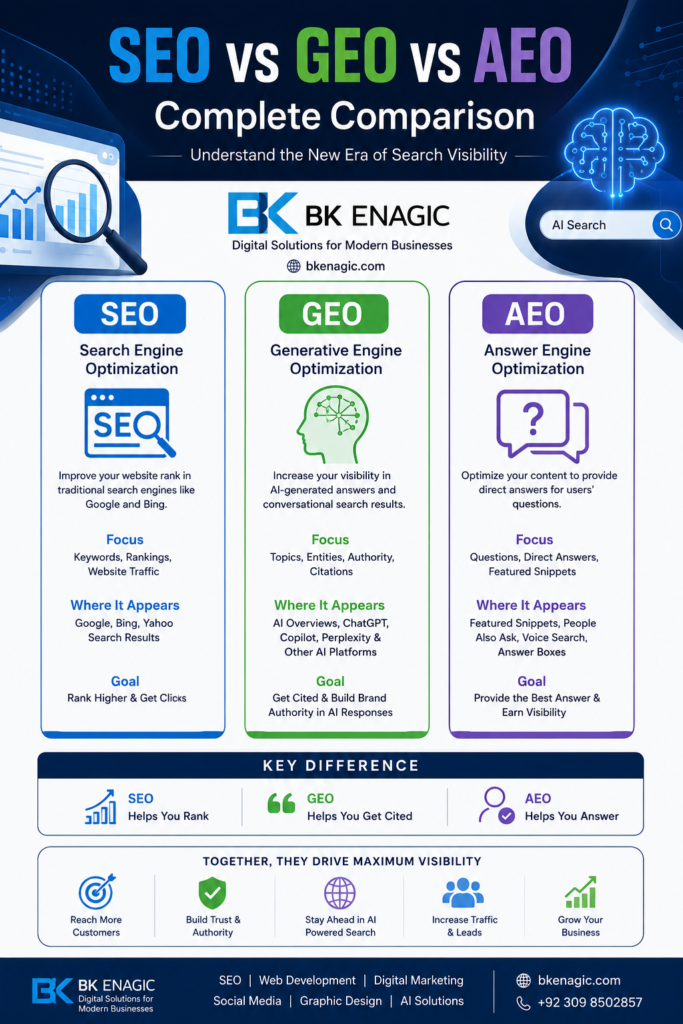
SEO vs GEO vs AEO: Quick Comparison
| Feature | SEO | GEO | AEO |
|---|---|---|---|
| Full Name | Search Engine Optimization | Generative Engine Optimization | Answer Engine Optimization |
| Main Goal | Rank pages in search results | Earn visibility or citations in AI responses | Provide the clearest direct answer |
| Main Platforms | Google, Bing and other search engines | AI assistants and generative search experiences | Featured snippets, voice assistants and answer engines |
| Main Target | Keywords and search intent | Topics, entities, authority and citations | Questions and concise answers |
| Typical Result | Organic ranking and website click | Brand mention, citation or supporting link | Extracted answer or featured result |
| Important Content Style | Comprehensive and optimized | Evidence-based, authoritative and easy to reference | Direct, conversational and structured |
| Common Measurement | Rankings, clicks, impressions and conversions | Citations, mentions, referral traffic and AI visibility | Featured answers, question visibility and engagement |
The Main Difference Between SEO, GEO and AEO
The simplest way to understand these strategies is to look at the result each one is trying to achieve.
SEO helps your webpage rank.
AEO helps your content answer.
GEO helps your information become part of an AI-generated response.
However, these areas are not completely separate. A high-quality page can perform well across all three.
Google officially states that traditional SEO best practices remain relevant to its generative AI features. Google also describes AEO and GEO as terms used for work focused on AI visibility, while treating optimization for its generative Search experiences as part of SEO rather than a completely separate system.
This means businesses should not abandon SEO. Instead, they should strengthen SEO with answer-focused formatting and content that can be understood and trusted by AI systems.
How SEO Works
SEO begins with understanding what people search for and why they search for it.
A page is then created or improved to satisfy that intent. Search engines evaluate factors such as relevance, website quality, technical accessibility, content usefulness, internal structure and authority.
SEO may involve optimizing:
- Page titles
- Meta descriptions
- Headings
- URLs
- Images
- Keyword placement
- Page speed
- Mobile usability
- Internal links
- Backlinks
- Local business information
The ideal SEO page does more than repeat a keyword. It answers the searcher’s needs and guides them toward a useful next step.
How GEO Works
GEO focuses on making content easy for generative systems to retrieve, interpret and reference.
An AI system may explore several related subtopics before preparing an answer. Google refers to one version of this process as query fan-out, in which related searches are generated to find supporting information for a complex question.
To improve GEO readiness, content should:
- Cover the main topic comprehensively
- Include clear definitions
- Use descriptive headings
- Identify brands, products and people consistently
- Support important claims with reliable evidence
- Include original examples or expert observations
- Avoid vague or misleading statements
- Keep important information updated
- Make key facts available in readable text
- Build a trustworthy presence beyond one webpage
Microsoft’s guidance also recommends clear headings, tables, FAQ sections, supporting evidence and regularly updated information. Bing Webmaster Tools now includes AI-performance reporting that can show citations, cited pages and grounding queries across supported Microsoft AI experiences.
How AEO Works
AEO starts by identifying the exact questions customers ask.
The content should then provide a clear answer near the beginning of the relevant section.
A useful AEO format is:
- Add the question as a heading.
- Give a direct answer in one or two sentences.
- Explain the answer in more detail.
- Add examples, steps or a comparison table.
- Link to related information where appropriate.
For example:
What is the difference between SEO and GEO?
SEO improves a website’s visibility in traditional search results, while GEO improves its visibility within AI-generated answers and citations.
That first sentence is concise enough to be extracted as an answer. The following paragraphs can then provide a more complete explanation.
The Role of Structured Data
Structured data helps search engines understand the meaning and classification of content on a webpage. It can describe elements such as an organization, service, product, article, author or local business.
Google explains that structured data gives its systems explicit clues about page content and may make a page eligible for certain rich results. Google generally recommends JSON-LD when it is suitable for the website’s setup.
Useful structured-data types may include:
- Organization
- LocalBusiness
- Article
- BreadcrumbList
- Product
- Service
- Person
- VideoObject
Structured data must accurately match the visible page content. It should not be used to describe information that users cannot see dulhahouse.
It is also important to understand that schema markup does not guarantee rankings, featured answers or AI citations. It supports content understanding but cannot replace strong content and technical SEO.
Does GEO Replace SEO?
No. GEO does not replace SEO.
Generative systems often depend on searchable, accessible and well-structured online information. A website that cannot be crawled, indexed or understood may struggle to gain visibility in both traditional and AI-powered search experiences.
Google specifically confirms that pages must remain indexed and eligible for standard Search before they can appear as supporting links in its AI features. It also states that there are no separate technical requirements for appearing in AI Overviews or AI Mode.
SEO therefore provides the foundation, while GEO and AEO extend how content can be discovered and presented.
Does AEO Replace SEO?
AEO does not replace SEO either.
AEO is best viewed as an answer-focused layer within a broader search strategy. A page may provide an excellent short answer, but it still needs technical accessibility, useful supporting information and a trusted website behind it.
AEO without SEO may produce content that is easy to read but difficult to discover.
SEO without AEO may produce a page that ranks but fails to answer the user’s question quickly.
The strongest strategy combines both.
Which Strategy Is Best for Your Business?
Most businesses should not choose only one of these approaches.
They should combine SEO, GEO and AEO according to their audience and objectives.
Use SEO when you want to:
- Improve Google rankings
- Generate organic traffic
- Rank service and product pages
- Increase local visibility
- Build long-term search authority
- Generate leads from high-intent searches
Use GEO when you want to:
- Improve brand visibility in AI tools
- Increase the likelihood of earning citations
- Establish your company as a trusted source
- Prepare content for generative search
- Track brand mentions across AI platforms
- Strengthen authority around important topics
Use AEO when you want to:
- Target question-based searches
- Appear in direct-answer formats
- Improve voice-search readiness
- Target featured snippets
- Make content easier to understand
- Answer customer questions quickly
How to Optimize Content for SEO, GEO and AEO Together
A unified strategy is more efficient than creating separate content for every platform.
1. Research keywords and real questions
Use keyword research to identify traditional search terms. Then study customer conversations, sales questions, support queries and People Also Ask results to find conversational questions.
2. Match the correct search intent
Determine whether the user wants information, a comparison, a service, a product or a local provider.
The format of the content should reflect that intention.
3. Provide a direct answer
Answer the main question clearly within the introduction or the relevant section.
Avoid forcing users to read several paragraphs before finding the basic answer.
4. Add meaningful depth
After providing the direct answer, include supporting explanations, practical examples, comparisons and expert insights.
This combination supports both AEO and GEO while improving the overall SEO value of the page.
5. Strengthen experience and credibility
Include:
- Original observations
- Author information
- Real examples
- Case studies
- Research sources
- Updated statistics
- Transparent business details
- Clear contact information
Do not publish unsupported claims simply to influence an AI-generated response.
6. Improve technical SEO
Make sure the website:
- Loads quickly
- Works properly on mobile devices
- Uses HTTPS
- Can be crawled
- Has an XML sitemap
- Uses logical internal links
- Has clean URLs
- Avoids duplicate content
- Provides important information in text
- Uses accurate structured data
7. Build topic clusters
Create a main guide supported by related articles.
For example, a digital marketing agency could publish:
- What Is SEO?
- What Is Local SEO?
- What Is GEO?
- What Is AEO?
- SEO vs PPC
- How AI Is Changing Search
- How to Optimize Content for AI Answers
Linking these pages together helps users and search systems understand the website’s expertise.
8. Maintain consistent brand information
Your company name, services, location, contact details and descriptions should remain consistent across your website and trusted third-party profiles.
Consistency helps search and AI systems identify your business as the same entity across different sources.
9. Update important content
Review important pages regularly to remove outdated information, repair broken links and improve incomplete sections.
Content freshness is especially important for subjects that change quickly, including technology, prices, policies and digital-marketing platforms.
10. Measure the correct results
For SEO, measure:
- Keyword rankings
- Search impressions
- Organic clicks
- Click-through rate
- Leads
- Sales and conversions
For GEO, monitor:
- AI citations
- Brand mentions
- Referenced pages
- AI referral traffic
- Visibility for important prompts
- Assisted conversions
For AEO, monitor:
- Featured snippets
- Question-based impressions
- Voice and conversational searches where measurable
- Engagement with FAQ content
- Click-through rate
- Conversions from informational pages
Common SEO, GEO and AEO Mistakes
Avoid these common errors:
- Publishing large amounts of generic AI-generated content
- Repeating keywords unnaturally
- Creating fake statistics or citations
- Hiding the direct answer
- Ignoring technical SEO
- Using unsupported schema markup
- Writing only for algorithms
- Copying competitors without adding value
- Allowing important pages to become outdated
- Expecting guaranteed AI citations
- Treating GEO as a collection of shortcuts
- Measuring traffic without tracking leads or revenue
Google’s current guidance prioritizes unique, useful, expert-led content and warns businesses against relying on unnecessary GEO or AEO “hacks.”
Final Verdict: SEO vs GEO vs AEO
SEO, GEO and AEO serve different purposes, but they work best together.
SEO builds your website’s foundation and improves traditional search visibility.
AEO organizes your content around direct, useful answers.
GEO prepares your brand and information for generative search experiences where AI systems may summarize, cite or recommend online sources.
The future of search is not simply about ranking first for one keyword. It is about becoming a trusted, accessible and useful source across search engines, answer platforms and AI-powered experiences.
Grow Your Visibility with BK Enagic
BK Enagic provides digital solutions designed to help businesses compete in the changing online marketplace. Our services include search-engine optimization, web development, digital marketing, social media management, graphic design and AI-powered marketing solutions.
Whether your business needs stronger Google rankings, better website content or an AI-ready digital strategy, BK Enagic can help you build a complete online presence focused on visibility, leads and measurable growth.
Visit bkenagic.com to start improving your digital presence today.
Frequently Asked Questions
What is the difference between SEO, GEO and AEO?
SEO focuses on ranking webpages in traditional search results. GEO focuses on visibility and citations in generative AI responses. AEO focuses on providing direct answers for question-based searches and answer engines.
Is GEO better than SEO?
GEO is not necessarily better than SEO. SEO provides the technical and content foundation that can also support visibility in generative search. Most businesses need both.
Is AEO part of SEO?
AEO can be considered an answer-focused part of a broader SEO strategy. It uses clear questions, concise answers and structured content to improve visibility in direct-answer experiences.
Can one page be optimized for SEO, GEO and AEO?
Yes. A well-structured page can target relevant keywords, answer important questions and provide reliable information that AI systems may reference.
Does schema markup guarantee AI visibility?
No. Structured data can help search engines understand content, but it does not guarantee rankings, featured snippets or AI citations.
How can a business measure GEO performance?
Businesses can monitor AI citations, brand mentions, referenced URLs, AI referral traffic and conversions. Supported tools such as Bing Webmaster Tools can also provide data about citations in certain AI experiences.
Should small businesses invest in GEO?
Small businesses should first establish solid website, SEO and content foundations. They can then improve GEO readiness by publishing accurate, locally relevant and expert-led content that answers real customer questions.


Write a Comment